
Piping Cone Practice: Training Lines
These piping practice exercises for beginners help you improve icing control, pressure, and line stability when decorating cookies.
Exercises designed to develop control over icing flow when decorating cookies and improve line stability.
If you're learning how to decorate cookies step by step, start with the full cookie decorating process .
Why Practice Is Important
Working with royal icing is a skill that develops through repetition.
Even with properly prepared icing and a good understanding of how to work with a piping cone, the final result depends directly on practice.
Clean lines, neat endings, and steady icing flow do not appear immediately. They cannot be fully understood in theory - they develop only through regular practice.
Practice helps you:
- feel the correct pressure in the piping cone
- control the flow of icing
- stop the line at the right moment
- make your movements calmer and more confident
Preparing the Piping Cone
Before starting the exercises, it is important to prepare the piping cone correctly. This helps prevent problems with icing flow and makes lines smoother and more consistent.
After transferring icing into the cone, small air bubbles may appear inside. They form during the filling process and can interfere with smooth icing flow.
To remove excess air:
- Place the piping cone on the table.
- Gently smooth the icing inside the cone.
- Slide your hand from the tip upward, spreading the icing.
- Then use the edge of your palm to push the icing back toward the tip.
These movements help remove trapped air and make the icing inside the cone more uniform.
After that, tie the cone tightly at the top.
It is also important to hold the cone correctly during work.
Hold the cone between your thumb and the rest of your fingers, gripping the upper part of the cone just below the knot.
When the cone is held in this position, gentle pressure pushes the icing downward toward the tip instead of forcing it upward. This grip helps control pressure and ensures a stable icing flow.
Proper icing flow also depends on consistency. If you're not sure how icing should behave, see the royal icing consistency guide .
Training Lines
To develop basic piping control, several simple line types are used during practice:
- straight lines
- dashed lines
- wavy lines
- zigzag lines
Each line type trains different aspects of working with a piping cone:
These exercises help improve piping control for cookie decorating.
- pressure control
- movement rhythm
- stopping and resuming the icing flow
- line smoothness and stability
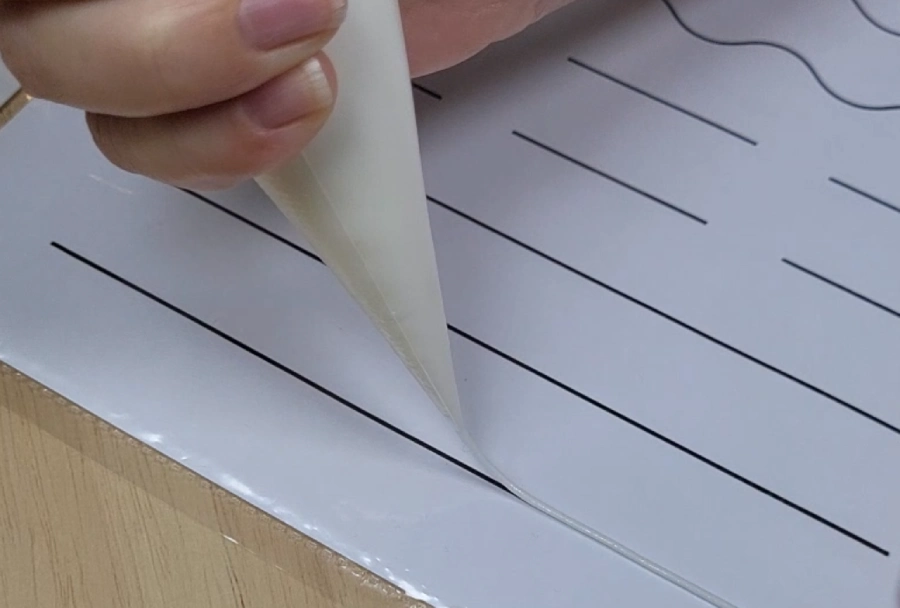
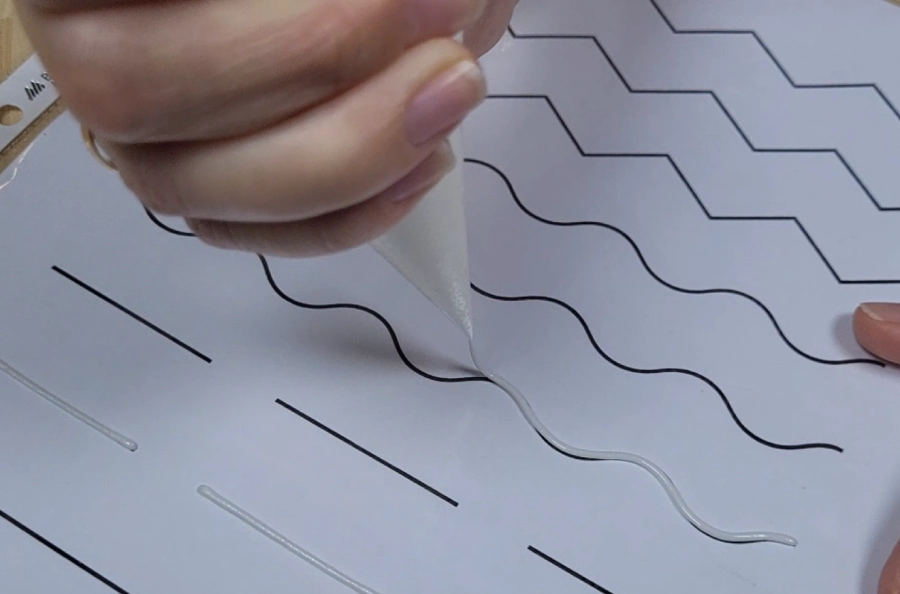
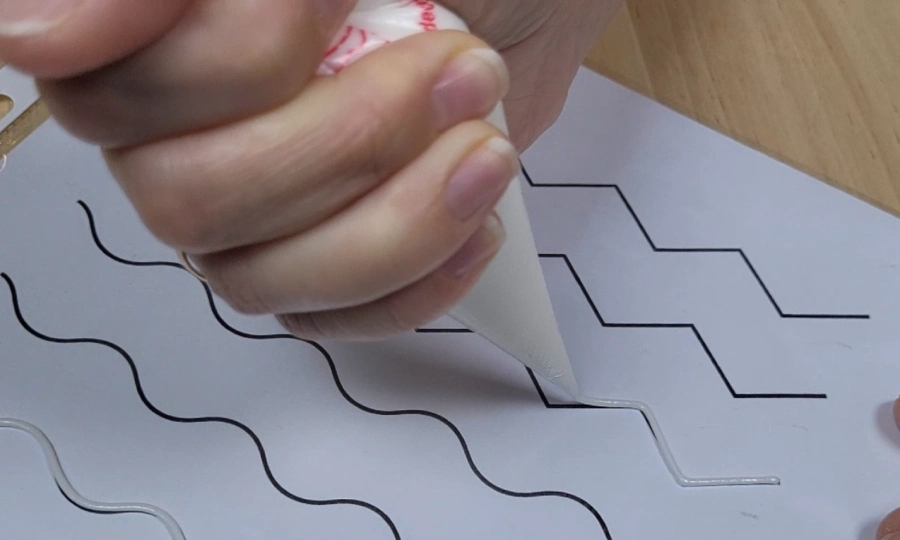
Based on these line types, a separate practice file has been prepared.
Download training sheets (PDF)
How to Use the Practice Sheets
- Print the file on an A4 sheet.
- Place the sheet inside a transparent plastic sleeve.
- Pipe the lines with icing over the sleeve or directly on the sheet to train your hand.
Work calmly and without rushing.
Try to focus not on speed, but on consistent icing flow and movement control.
Mistakes are a normal part of learning.
Wipe the lines away and repeat the exercises as many times as needed.
How Often to Practice
The best results come from regular practice without fatigue.
Even short practice sessions:
- help your hand get used to the correct pressure
- improve icing flow control
- make movements more confident
Over time, you will notice that your lines become straighter and working with a piping cone becomes calmer and more predictable.
Conclusion
Practice is the foundation of confident work with royal icing.
The more often you return to simple exercises, the easier it becomes to control the piping cone and create clean lines.
Over time, these basic skills make it much easier to handle details and more complex decorative elements in cookie decorating.
Once you feel comfortable with basic lines, you can apply these skills when outlining cookies. Continue with how to outline cookies with royal icing .